Give It All Away: How Greenville's Most Gifted Artists Found Purpose in the Classroom
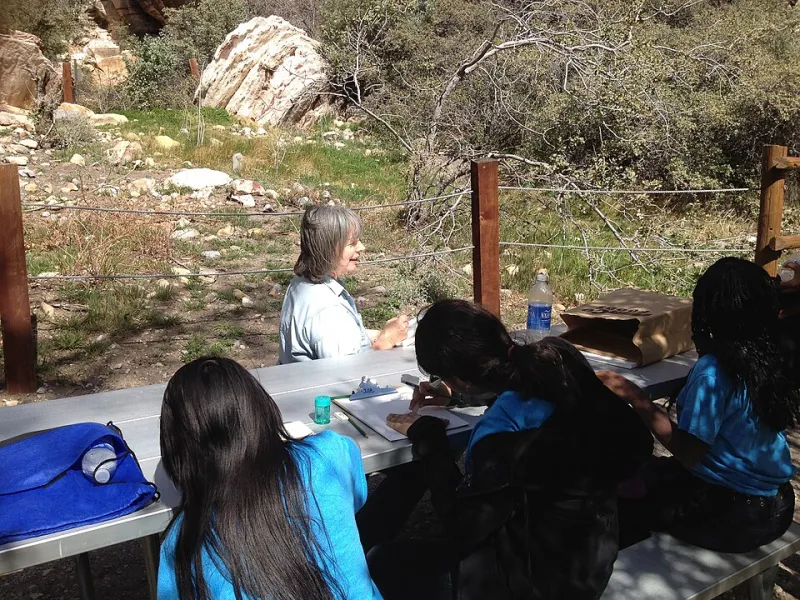
Photo: BLM Nevada, Public domain, via Wikimedia Commons
There's a version of the artist's life that looks like this: a studio full of light, uninterrupted hours, a body of work slowly accumulating meaning. Nobody knocking on the door. Nobody asking you to explain yourself.
Then there's the version that actually pays rent in Greenville.
For a growing number of the city's most inventive creators, the studio has become a part-time address. The other half of their lives — sometimes more than half — belongs to students. To workshops. To curriculum planning and critique sessions and the particular exhaustion of holding space for someone else's creative crisis when you've got your own brewing back home.
It's a tension that doesn't get talked about enough in conversations about Greenville's art scene. We spend a lot of time celebrating what's being made here. We spend less time asking what it costs the people making it.
The Shift Nobody Planned For
Ask around and you'll find the same story told a dozen different ways. Artists who came up through Greenville's scrappier years — the warehouse shows, the pop-up galleries, the days when the West End felt like it was being invented in real time — now find themselves fielding DMs from younger creators asking for advice, coffee, a studio visit, a recommendation letter.
The demand for mentorship didn't arrive with a memo. It just showed up, quietly and persistently, as Greenville's creative community grew into something with actual infrastructure. More programs. More residencies. More institutions with budgets for artist educators. And with that infrastructure came an implicit expectation: if you've made it, you owe something back.
Painter and installation artist Renata Osei, who's been working in Greenville for nearly a decade, describes the shift as gradual and then suddenly overwhelming. "I started saying yes to one workshop, then another, then I was guest-critiquing at two different programs," she says. "I looked up and realized I hadn't finished a new piece in four months."
She's not bitter about it. That's the complicated part.
"There's something that happens when you watch a student break through something," she says. "It's genuinely moving. I'm not going to pretend it isn't. But it also takes something from you that you don't always get back by the end of the day."
What Teaching Actually Does to the Work
The conventional wisdom — the romantic version — is that teaching enriches an artist's practice. Forces you to articulate things you'd otherwise leave intuitive. Keeps you sharp. Keeps you humble.
And sometimes that's true. Sculptor Marcus Delray, who splits his time between his studio on Augusta Street and a part-time position at a local arts nonprofit, says the questions his students ask have genuinely redirected his thinking. "They don't have the same hang-ups I have," he says. "They'll ask why I'm doing something a certain way, and I'll realize I've been doing it out of habit for six years."
But Delray is also honest about the math. He teaches because the math requires it. His practice — large-scale fabricated pieces that take months and significant material costs — doesn't generate consistent income between commissions. Teaching fills the gap. "I'm not complaining," he says carefully. "But I want to be clear that I didn't choose this because it was my dream. I chose it because the alternative was moving somewhere cheaper and starting over."
That particular calculus — teach or leave — is one that Greenville's creative economy has quietly imposed on a lot of talented people. The city has become more expensive without becoming proportionally more lucrative for working artists. The galleries are better, the audiences more sophisticated, the cultural ambition higher. The checks haven't quite kept pace.
The Mentorship Economy
What's emerged, almost organically, is something you could call a mentorship economy. Experienced artists trading knowledge for income, stability, and community standing. Younger artists absorbing that knowledge and, eventually, cycling back into the same role themselves.
It's not a bad system, exactly. In some ways it's a genuinely beautiful one — a living transmission of craft and perspective that no grant program could replicate. The Greenville artists who've come up through informal mentorship networks talk about those relationships with a reverence that's hard to fake.
But it does raise questions about who bears the cost. Mentorship, even when it's compensated through institutional roles, is labor. Emotional labor, intellectual labor, the labor of being endlessly available and endlessly encouraging when your own work is sitting unfinished in a corner.
Multidisciplinary artist and educator Priya Nambiar, who runs a community-based arts program in the Nicholtown neighborhood, has thought about this more than most. "We ask artists to be teachers, community organizers, advocates, administrators," she says. "And we celebrate them for it. But we don't always ask whether that's sustainable. Whether the work is still happening underneath all of it."
For Nambiar, it is — but she's protective about how. She guards certain hours. Certain projects. Refuses to let the teaching identity fully absorb the artist identity. "If I stop making," she says, "I stop having anything real to teach."
The Question of Vision
Here's the uncomfortable version of the question: does sustained mentorship dull the edge?
It's possible to imagine an artist whose most radical instincts get smoothed out through years of explaining, justifying, making accessible. Teaching requires a kind of translation. And translation, done long enough, can start to feel like the original language.
Not everyone agrees this is a risk. Osei pushes back hard. "My work has gotten stranger since I started teaching, not safer," she says. "Because I'm constantly around people who don't know the rules yet. That's actually liberating."
But she acknowledges the question is worth sitting with. "The artists I worry about are the ones who've completely stopped thinking of themselves as artists," she says. "Who've made peace with being teachers and nothing else. I don't think that's good for them. And I don't think it's good for the students either."
What Greenville Owes Its Artists
If there's a systemic argument lurking underneath all of this, it's a familiar one: a city that wants a vibrant creative culture has to be willing to fund one. Not just through programs and residencies — though those matter — but through the kind of economic conditions that allow artists to actually make art without exhausting themselves in the process.
Greenville has made real progress on this front. The public art investments, the nonprofit ecosystem, the growing collector base — these are genuine achievements. But the artists doing the most to shape the city's creative identity are still largely navigating a system that asks a lot and offers just enough.
Teaching is how many of them stay. And staying, for now, might be the most avant-garde thing they can do.
The work will come when it can. In the meantime, the classroom is full, and the students are lucky — even if they don't entirely know it yet.